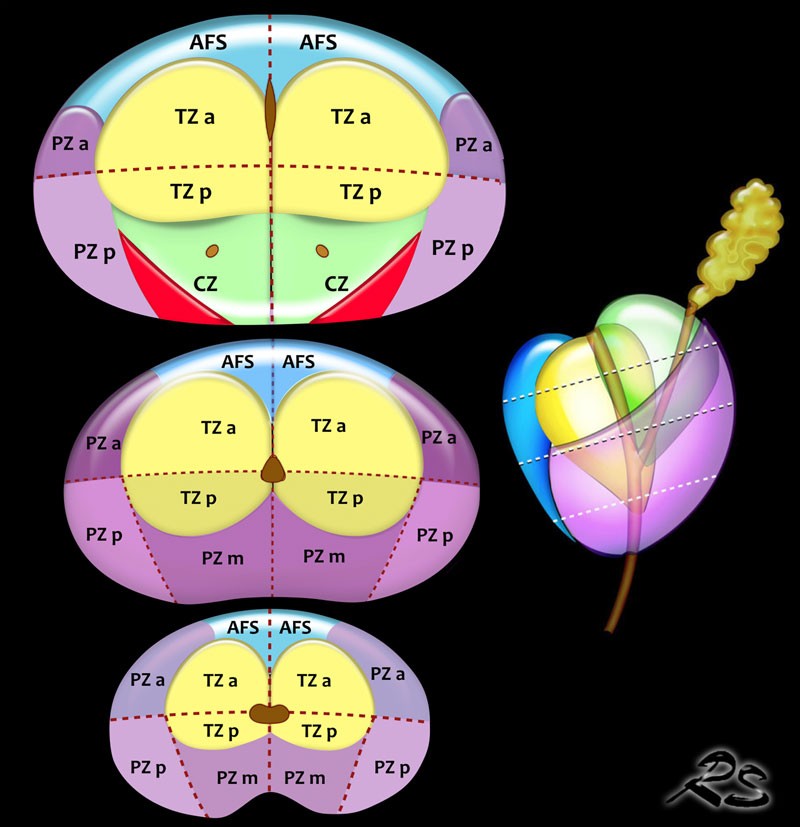
Peripheral Zone
DWI-dominant scoring
Transition Zone
T2W-dominant scoring
About This Tool
This interactive tool helps healthcare professionals systematically evaluate prostate lesions using multiparametric MRI. Select a zone above to calculate PI-RADS scores based on ACR/ESUR v2.1 guidelines.
Instant PI-RADS scoring based on ACR/ESUR v2.1 guidelines
Track and review previous calculations
Generate printable reports for documentation
Works seamlessly on all devices
What is PI-RADS 2.1?
PI-RADS (Prostate Imaging Reporting and Data System) version 2.1 is an internationally recognized standardized reporting system developed jointly by the American College of Radiology (ACR) and European Society of Urogenital Radiology (ESUR). It provides a structured framework for radiologists to interpret prostate multiparametric MRI (mpMRI) and assess the likelihood of clinically significant prostate cancer.
This calculator helps healthcare professionals systematically evaluate prostate lesions using diffusion-weighted imaging (DWI), T2-weighted imaging (T2W), and dynamic contrast-enhanced (DCE) sequences to generate a PI-RADS score that predicts cancer risk.
This calculator is based upon the American College of Radiology (ACR) PI-RADS 2.1 classification but is not officially endorsed by the ACR. The author makes no claims of the accuracy of the information contained herein; this information is for educational purposes only and is not a substitute for clinical judgment.
π΅ Peripheral Zone Calculator
π’ Transition Zone Calculator
π Prostate Volume & PSA Density Calculator
π Results History
Your calculation history is saved locally in your browser. Results are preserved between sessions.
π PI-RADS 2.1 Assessment Categories
PI-RADS 2.1 employs a 5-point scale based on the likelihood that mpMRI findings correlate with clinically significant cancer.
Clinically significant cancer is highly unlikely to be present. These lesions typically require no further follow-up.
Clinically significant cancer is unlikely. These findings generally do not warrant immediate biopsy in the absence of other risk factors.
The presence of clinically significant cancer is equivocal. Management should incorporate additional clinical factors such as PSA density.
Clinically significant cancer is likely. Biopsy is strongly recommended, with MRI-targeted approaches preferred.
Clinically significant cancer is highly likely. These lesions mandate tissue diagnosis and expedited clinical management.
Peripheral Zone β DWI Dominant
Peripheral Zone Scoring Algorithm:
- DWI=1 or 2: Direct PI-RADS 1 or 2 (no DCE needed)
- DWI=3: Requires DCE: negativeβPI-RADS 3; positiveβPI-RADS 4
- DWI=4 or 5: Direct PI-RADS 4 or 5 (no DCE needed)
Transition Zone β T2W Dominant
Transition Zone Scoring Algorithm:
- T2W=1: PI-RADS 1 (no DWI needed)
- T2W=2: DWI β€3 β PI-RADS 2; DWI β₯4 β PI-RADS 3 (upgrade)
- T2W=3: DWI β€4 β PI-RADS 3; DWI=5 β PI-RADS 4 (upgrade)
- T2W=4 or 5: Direct PI-RADS 4 or 5 (no DWI needed)
PI-RADS 2.1 Assessment Tables
Official ACR/ESUR v2.1 cross-tables. In the peripheral zone, DWI is dominant and DCE is only a tie-breaker for DWI 3; in the transition zone, T2W is dominant and DWI upgrades the equivocal categories.
Peripheral Zone (DWI dominant)
| DWI | DCE | PI-RADS |
|---|---|---|
| 1 | Any | 1 |
| 2 | Any | 2 |
| 3 | Negative (β) | 3 |
| 3 | Positive (+) | 4 |
| 4 | Any | 4 |
| 5 | Any | 5 |
Transition Zone (T2W dominant)
| T2W | DWI | PI-RADS |
|---|---|---|
| 1 | Any | 1 |
| 2 | β€ 3 | 2 |
| 2 | β₯ 4 | 3 2+1 upgrade |
| 3 | β€ 4 | 3 |
| 3 | 5 | 4 3+1 upgrade |
| 4 | Any | 4 |
| 5 | Any | 5 |
Size / EPE rule: a lesion otherwise scored 4 is upgraded to PI-RADS 5 when it measures β₯ 1.5 cm or shows definite extraprostatic extension.
Whole-gland score: equals the highest-scoring (index) lesion.
PI-RADS v2.1 Decision Flowcharts
Visual summary of how the peripheral zone (ADC/DWI-dominant) and transition zone (T2W-dominant) scoring algorithms combine into the final PI-RADS assessment category.
Clinical Decision-Making
PI-RADS 1-2 (Low Suspicion): Biopsy not recommended absent other compelling factors. Negative predictive value is high.
PI-RADS 3 (Equivocal): Management varies by location and clinical factors. Consider PSA density, follow-up MRI, or risk-stratified approaches.
PI-RADS 4-5 (High Suspicion): Biopsy recommended. MRI-targeted approaches show superior detection compared to systematic biopsies alone.
Key Technical Parameters
- Field Strength: Both 1.5T and 3.0T acceptable; 3.0T preferred for superior SNR
- DWI b-values: ADC with b=0-100 and b=800-1000 s/mmΒ²; high b-value DWI at b=1400-2000 s/mmΒ²
- DCE Temporal Resolution: <15 seconds to capture early enhancement
- Post-biopsy Interval: β₯6 weeks for staging purposes
Version 2.1 Updates from 2.0
Version 2.1 clarified several ambiguities from version 2.0:
- Improved transition zone scoring with explicit upgrading rules (2+1 and 3+1)
- More precise DWI criteria distinguishing focal from linear/wedge-shaped abnormalities
- Clarified measurement standardization and prostate volume calculation
- Enhanced peripheral and transition zone morphologic descriptions
Diagnostic Performance
Clinically Significant Cancer Detection (PI-RADS β₯4):
- Sensitivity: 0.83-0.90
- Specificity: 0.48-0.66
- Area Under Curve: 0.86-0.90
Inter-reader Agreement (Kappa): 0.40-0.60 (moderate to good). PI-RADS 3 has greatest variability.
Prostate Cancer TNM Staging
Standard AJCC/UICC TNM staging for prostate cancer (8th edition). MRI findings such as extraprostatic extension (T3a) and seminal vesicle invasion (T3b) directly inform clinical T-stage.
| Category | Definition |
|---|---|
| T β Primary Tumor | |
| T1 | Clinically inapparent tumor, not palpable or visible by imaging |
| T2 | Tumor confined within the prostate (T2a β€ half of one lobe; T2b > half of one lobe; T2c both lobes) |
| T3a | Extraprostatic extension (unilateral or bilateral), or microscopic bladder neck invasion |
| T3b | Tumor invades seminal vesicle(s) |
| T4 | Tumor is fixed or invades adjacent structures other than seminal vesicles: external sphincter, rectum, bladder, levator muscles and/or pelvic wall |
| N β Regional Lymph Nodes | |
| N0 | No regional lymph node metastasis |
| N1 | Regional lymph node metastasis |
| M β Distant Metastasis | |
| M0 | No distant metastasis |
| M1a | Non-regional lymph node(s) |
| M1b | Bone(s) |
| M1c | Other site(s), with or without bone disease |
References
- American College of Radiology. PI-RADS Prostate Imaging β Reporting and Data System, Version 2.1. ACR, 2019.
- Turkbey B, Rosenkrantz AB, Haider MA, et al. Prostate Imaging Reporting and Data System Version 2.1: 2019 Update. Eur Urol. 2019;76(3):340-351.
- Weinreb JC, Barentsz JO, Choyke PL, et al. PI-RADS Prostate Imaging β Reporting and Data System: 2015, Version 2. Eur Urol. 2016;69(1):16-40.
- The Radiology Assistant. Prostate Cancer β PI-RADS v2.1. radiologyassistant.nl.
- Amin MB, Edge SB, et al. (eds). AJCC Cancer Staging Manual, 8th ed. β Prostate. American Joint Committee on Cancer, 2017.
Medically reviewed by Dr. Amar Udare, MD, DNB Β· Last reviewed:
π PI-RADS v2.1 Report Generator
Complete the fields below to generate a copy-paste prostate MRI report that follows the official PI-RADS v2.1 reporting template (ACR, Appendix I) and sector-map nomenclature. Only the overall PI-RADS category per lesion is required; everything else is optional. Score a lesion in the Peripheral or Transition zone calculator, then click Generate Full PI-RADS Report to arrive here with that lesion pre-filled.
1 Β· Indication & Technique
2 Β· Gland & Background
3 Β· Lesions
Add one card per lesion. The overall category is auto-suggested from the sequence scores using PI-RADS v2.1 rules, but you can override it.
4 Β· Extraprostatic, Nodal & Other Findings
This generator is based on the American College of Radiology (ACR) PI-RADS v2.1 reporting template but is not officially endorsed by the ACR. It is for educational use and is not a substitute for clinical judgment. Do not enter protected health information (PHI).
β Frequently Asked Questions
What is a PI-RADS score?
A PI-RADS (Prostate Imaging Reporting and Data System) score is a 1 to 5 rating derived from multiparametric prostate MRI that estimates the likelihood of clinically significant prostate cancer. A score of 1 means it is highly unlikely and a score of 5 means it is highly likely.
Is PI-RADS 4 cancer?
A PI-RADS 4 does not confirm cancer. It means clinically significant cancer is likely (around 52%). MRI-targeted biopsy is recommended to establish a tissue diagnosis.
What does a PI-RADS 3 score mean?
PI-RADS 3 is equivocal, with roughly a 20% chance of clinically significant cancer. Management often incorporates PSA density (biopsy is favored when PSA density is 0.15 ng/mL/cc or higher) along with other clinical risk factors.
What is the difference between PI-RADS 2.0 and 2.1?
PI-RADS v2.1 (released in 2019) refined transition-zone scoring with explicit 2+1 and 3+1 upgrade rules, clarified DWI criteria distinguishing focal from linear or wedge-shaped abnormalities, and standardized DCE and prostate-volume measurement.
How is a transition zone lesion scored in PI-RADS 2.1?
In the transition zone, T2-weighted imaging is the dominant sequence. A T2W score of 2 is upgraded to PI-RADS 3 if DWI is 4 or 5, and a T2W score of 3 is upgraded to PI-RADS 4 if DWI is 5.
When is DCE (contrast) used in PI-RADS 2.1?
Dynamic contrast-enhanced (DCE) imaging only changes the score for peripheral-zone lesions with a DWI score of 3. Positive (focal, early) enhancement upgrades PI-RADS 3 to PI-RADS 4. DCE is not used to score transition-zone lesions.
Is this PI-RADS calculator free?
Yes. This PI-RADS v2.1 calculator is completely free to use and works on both desktop and mobile devices.